
Most companies run on off-the-shelf software for longer than people outside the organization would guess. A spreadsheet tracking something it was never designed to track. A CRM stretched to cover a workflow it doesn't actually support. None of that is a failure of judgment. Buying tools is cheaper, faster to adopt, and perfectly adequate for a huge share of what a growing business needs to do. The mistake isn't using generic software; it's not noticing the moment it stops being adequate.
That moment tends to arrive quietly. Nobody sends a memo announcing that the spreadsheet has become a liability. It shows up as a growing pile of manual workarounds, a process that takes longer every quarter instead of scaling with the business, or a compliance requirement that a generic tool simply has no way to satisfy. This article is built around recognizing that moment and deciding what to do once it arrives.
Signs the Tool You Bought Has Become the Bottleneck
A few patterns tend to show up together when an organization has genuinely outgrown a generic solution, as opposed to just needing to configure the tool better:
- Staff is maintaining manual workarounds (spreadsheets, duplicate data entry, side processes) to compensate for something the core tool can't do.
- The tool's limitations are shaping business decisions, rather than the business shaping how the tool is used.
- Data lives in multiple disconnected systems that don't talk to each other, and reconciling them has become a recurring task rather than a one-time setup problem.
- A regulatory, security, or scale requirement has appeared that the software's vendor has no roadmap to support.
- The cost of licenses, seats, or add-ons is climbing toward what a custom build would cost, without the software actually fitting the business any better.
One or two of these can usually be solved by better configuration or buying a different product. Several appearing at once, especially the regulatory and workaround patterns together, is a stronger signal that the underlying problem is architectural, not a matter of picking a better vendor.
The Case for Staying Off-the-Shelf
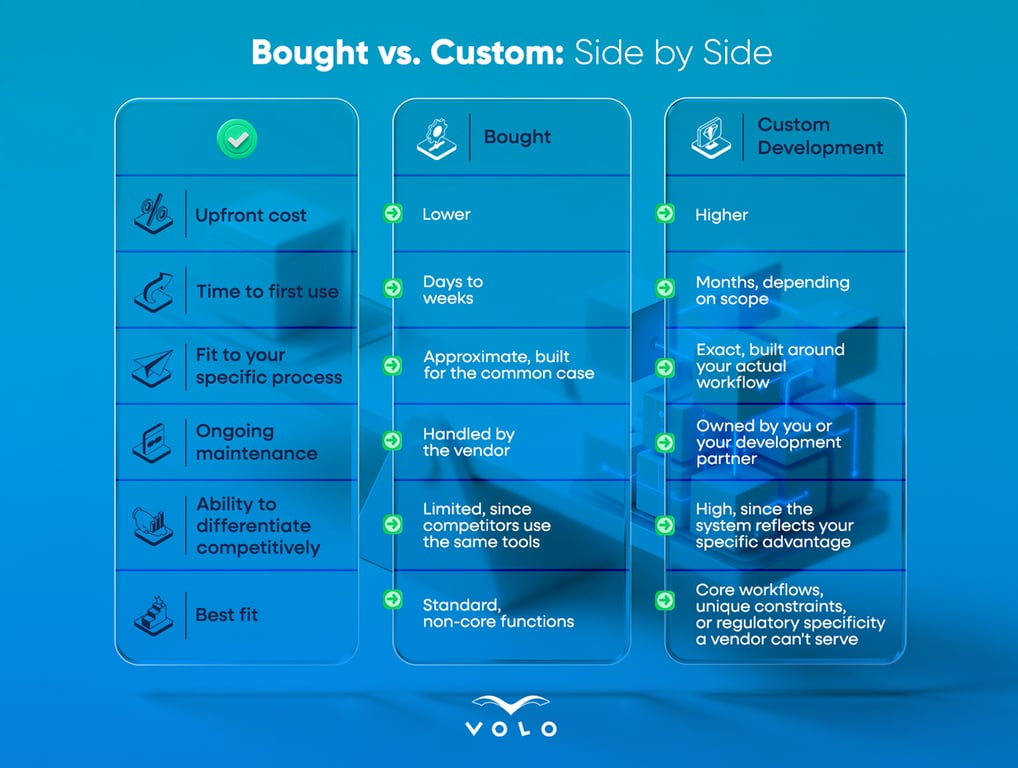
It's worth stating plainly what generic software still does better, because the decision isn't a foregone conclusion in favor of custom development. Off-the-shelf tools carry a lower upfront cost, get a team working within days instead of months, and come with a vendor absorbing the maintenance, security patching, and infrastructure burden. For a function that isn't core to what makes a business competitive (standard accounting, common project tracking, generic HR administration), buying is very often the right economic call and will remain the right call even as the company grows.
The decision to build custom software should be a response to a specific limitation, not a general ambition to have "better" systems. A company that replaces a perfectly adequate bought tool because a custom platform sounds more sophisticated is usually taking on cost and risk without a matching return.
Where the Economics Flip
The calculation changes when the workflow in question is either core to the business's competitive position or specific enough that no vendor has built a product around it. A useful test: does this process look like every other company's version of it, or is it genuinely particular to how this business operates? Off-the-shelf tools are built for the common case. When the common case doesn't match your reality, the software fights you instead of helping you, and every workaround is a small, compounding cost.
Three real situations illustrate different versions of this:
- A technical ceiling that no vendor product can clear. When Jabil needed a robotics system to detect hazards in unpredictable retail environments, existing vision technologies on the market couldn't reliably identify small objects or transparent liquids on the floor. No off-the-shelf perception software existed that solved that specific problem, so VOLO built a custom perception engine using computer vision and motion control, reaching over 95% detection accuracy and cutting manual inspection by 45% during the pilot phase. This wasn't a case of an off-the-shelf tool being poorly configured; the capability simply didn't exist in any packaged product.
- Scale and sensitivity outgrowing generic tools. Health Advocate, a healthcare advocacy company now serving more than 40 million members, reached a point where off-the-shelf software couldn't handle the scale, sensitivity, or complexity of its operations across client management, call center workflows, and reporting. VOLO built an integrated suite of business applications in 2008, and the partnership supporting that system has continued for over 15 years since. The trigger here wasn't a missing feature; it was that the volume and sensitivity of the data had outgrown what a generic platform could responsibly handle.
- A regulatory requirement moving faster than any vendor's roadmap. ProCredit Bank was tracking green loan impact assessments in Excel as environmental regulations tightened across the more than ten countries where it operates. Manual processes and growing data volume made that approach unsustainable, and no off-the-shelf ESG reporting tool was positioned to handle the bank's specific multi-country compliance requirements. VOLO built EcoModule, a custom platform automating the calculations and integrating with existing reporting tools, which has now supported the bank across more than a decade of green finance regulation.
What connects these three cases isn't industry or company size. It's that in each one, a generic tool wasn't simply inconvenient; it was structurally incapable of doing what the business needed, whether the limitation was technical, operational, or regulatory.
Bought vs. Custom: Side by Side
The Middle Path: Integrating Instead of Replacing
The choice isn't always a full replacement of one system with another. A common and often underrated approach is building a custom layer that integrates with existing off-the-shelf tools rather than replacing them outright, automating the specific workflow that's broken while leaving everything else in place. This tends to be less disruptive and less expensive than a full platform rebuild, and it's frequently the right answer when only one piece of a broader tech stack has actually outgrown its generic tool. Whether a full custom build or a targeted integration is the better fit is itself worth a proper technical assessment before committing to either path.
Making the Decision
A short set of questions tends to clarify which side of this line an organization is actually on. Is the limitation about a missing feature, or about the software fighting how the business fundamentally operates? Is the workflow in question something that differentiates the business competitively, or is it a standard function every company handles the same way? Would the cost of continuing to work around the limitation, in staff time, errors, or missed opportunities, exceed the cost of building something purpose-fit within a reasonable timeframe? And is there a regulatory or scale requirement on the horizon that no vendor roadmap currently addresses?
Once the answer points toward custom development, the next decisions are about how to execute it well. That includes choosing the right engagement model for the build and evaluating a development partner with the technical judgment and domain experience to get it right the first time. It's also worth revisiting where custom software fits within the broader landscape of software company types, since enterprise software vendors, consulting firms, and development partners each play a different role depending on which side of this decision you land on.
If your organization is somewhere in the middle of this question, still not entirely sure whether the problem is the tool or how it's being used,VOLO's team can help assess that before any build decision is made.