
Most companies make their first AI model decision by accident. A prototype gets built against whichever provider the engineering team already had API access to; that prototype becomes the production system, and the model choice that was never really a decision quietly becomes the architecture the whole system depends on. That default works fine until it doesn't, usually at the exact moment a compliance requirement, a pricing change, or a provider outage exposes how much was riding on a choice nobody deliberately made.
This piece is about making that decision on purpose: what a single-vendor AI stack actually costs and saves compared to a hybrid one, and the specific conditions under which each is the right call.
A Direct Definition
A single-vendor AI stack means every AI capability in a system (language generation, embeddings, retrieval) runs on models from one provider. A hybrid AI stack means different capabilities, or the same capability for different use cases, run on models from more than one provider, selected deliberately for reasons like cost, performance on a specific task, or data governance requirements.
Hybrid is not the same as "using multiple AI features." A product with a chatbot and a recommendation engine, both built on the same underlying model provider, is still a single-vendor stack. The distinction is about the number of model providers the architecture actually depends on, not the number of AI-powered features in the product.
Why This Decision Has Become More Consequential
Running more than one model in production is now common rather than exceptional. A 2025 survey of 100 enterprise CIOs by a16z found that 37% were using 5 or more AI models in production, up from 29% the year before. Some of that shift is deliberate architecture, choosing the best model for each specific task. Some of it reflects a real, growing concern about dependency: losing access to a single AI vendor, through an outage, a pricing change, or a policy shift, can disrupt a core business function if no fallback was ever designed.
None of this means every company needs a hybrid stack. It means the decision deserves more deliberate attention than it usually gets, since the cost of an accidental single-vendor dependency is higher now that AI sits inside production workflows rather than pilot projects.
Single-Vendor vs. Hybrid: A Direct Comparison
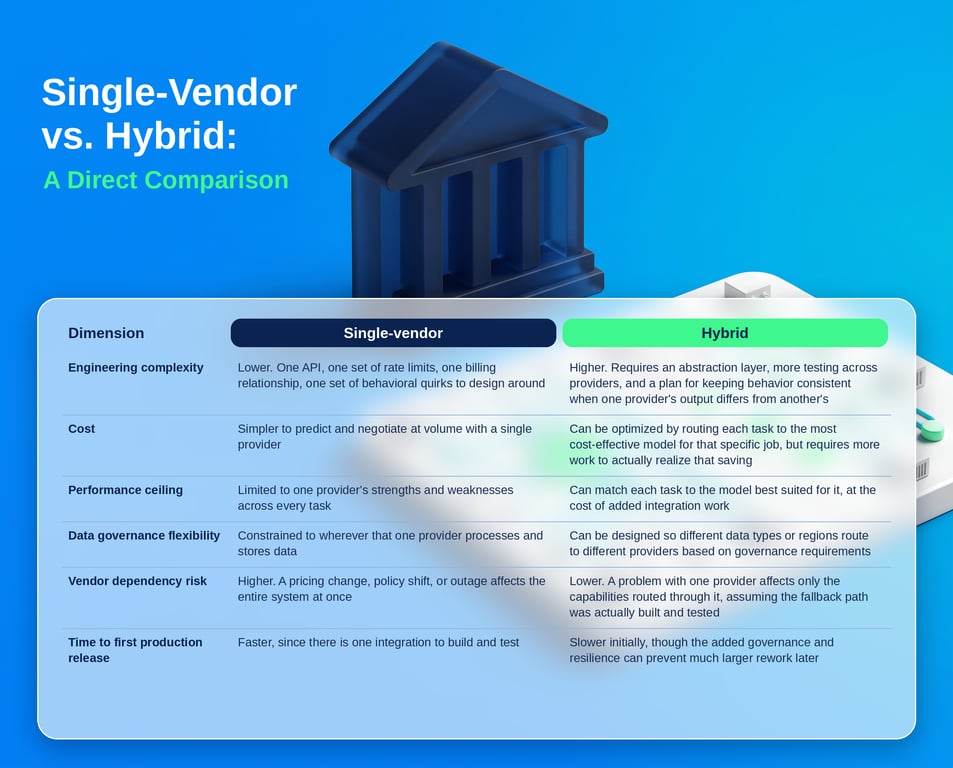
Where the Data Governance Question Gets Real
Data governance is the reason hybrid architecture stops being a nice-to-have and becomes a requirement, and it is worth walking through a real example of how that plays out.
On a global recruitment platform VOLO built AI capabilities for, the team combined OpenAI and Mistral within the same system rather than standardizing on one provider. The decision was not driven by cost optimization or a preference for one model's output quality. It was driven by data governance requirements tied to deployments across EU regions, where data processing and storage are compliance questions, not simply technical ones. Certain data needed a provider and infrastructure configuration that met those specific regional requirements, while other parts of the system had more flexibility.
This is the pattern worth generalizing: hybrid architecture driven by governance is not about using two providers for redundancy's sake. It is about recognizing that different pieces of data, or different regions a product operates in, can carry different processing requirements, and designing the model architecture around those requirements from the start rather than retrofitting it after a compliance review flags the problem.
When Single-Vendor Is the Right Call
A single-vendor stack is usually the right choice when the use case is contained to one region with one clean regulatory environment, when the team is early in an AI initiative and speed to a working system matters more than long-term flexibility, and when the data involved is not subject to strict residency or processing requirements. Forcing a hybrid architecture onto a use case that does not need one adds engineering overhead without a corresponding benefit.
When Hybrid Is the Right Call
Hybrid makes sense when data governance or regional compliance requirements genuinely differ across parts of the system, when a single point of vendor failure would disrupt a business-critical function and no acceptable downtime exists while switching providers, or when specific tasks have meaningfully different performance profiles across providers, and the cost of building the routing logic is justified by the gain. It is not justified purely by a general sense that "vendor lock-in is risky," since building and maintaining a hybrid architecture has a real, ongoing cost that needs a specific reason to outweigh.
A Short Framework for This Decision
Three questions determine which side of this decision a company is actually on:
- Does the data involved have different processing or residency requirements across regions or use cases? If yes, that is usually reason enough for hybrid architecture on its own.
- Would losing access to the primary AI provider disrupt a function the business cannot tolerate being down? If yes, a tested fallback path matters regardless of whether it is used day to day.
- Is the team building its first AI system, or its fifth? Early systems benefit from the simplicity of single-vendor architecture. Mature AI programs with several systems in production are the ones where a deliberate multi-provider strategy tends to pay for itself.
Where to Go From Here
Model architecture decisions like this one sit underneath most of the other AI implementation questions covered in VOLO's guide to enterprise AI implementation, since the governance approach chosen here affects what is possible later in an agent system or automation layer. VOLO'sAI services team designs and deploys AI systems across cloud, hybrid, and fully private infrastructure depending on what a specific use case and its data actually require.
Companies in finance, healthcare, or other regulated industries evaluating what this means for chatbot, call center, or fully private AI deployments specifically will find a more detailed look at those questions in an upcoming piece in this series.
If your team is making this architecture decision now and wants a second opinion on whether hybrid is actually necessary for your use case,book a consultation with VOLO.